Discovery & Conversion · Shop the Look
Lifestyle imagery, shoppable. Outfit looks, AI-composed.
Turn hero imagery into interactive lookbooks with coordinate-pinned product tagging, configurable two-column layouts, and AI-composed outfit looks grounded in regional trend signals. Deploy on PDPs or as curated lookbooks anywhere. Personalised per audience.
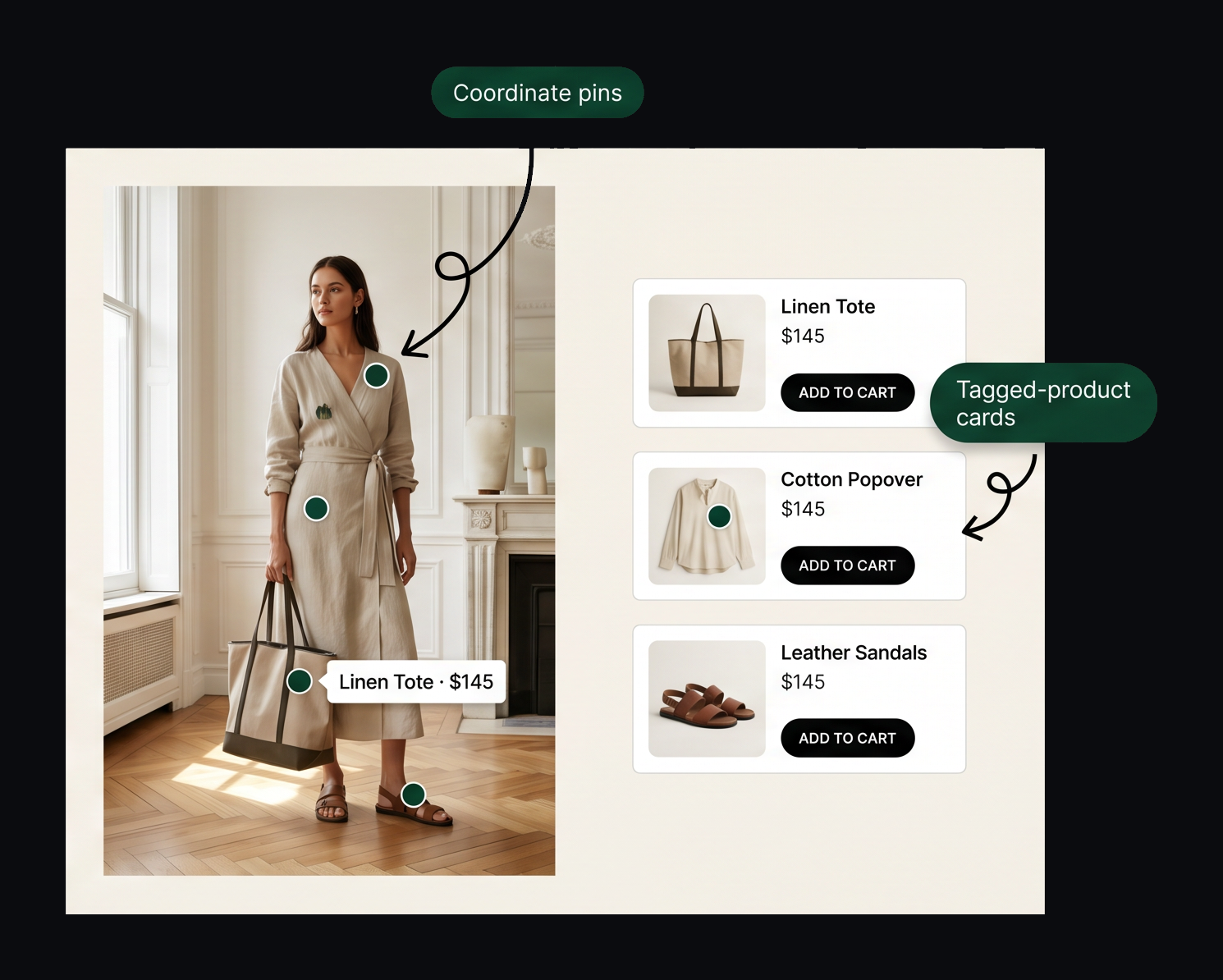
What it does
Editorial lookbooks that convert. Without the manual styling burden.
Coordinate pin product tagging
Pin specific products to exact positions on a lifestyle hero image or video. Tapping a pin pops a floating overlay product card anchored near the pin, with an add-to-cart CTA inline. No more product grids buried under the lookbook image.
Two surfaces: PDP and Curated
Shop the Look on PDPs surfaces looks tied to the current product, stacked as sections. Curated Shop the Look lets you hand-pick 1 to 20 looks via a reorderable list, deployable on any page (home, articles, custom landings). Both share the same metaobject schema, so no duplicate data to maintain.
AI-composed outfit looks
Provide anchor products, a creative brief, optional slot templates ("tops, bottoms, shoes"), and up to 5 inspiration images. The AI extracts visual cues (palette, vibe, silhouette, occasion, season), queries regional trend signals, and composes draft looks with rationale, vibe tags, and slot assignments. Each look is reviewable before publishing.
Five layout configurations
Hero image with grid cards, hero video with carousel cards, product-first 40:60 ratio, image-dominant editorial 60:40, and pin-to-card spotlight that dims non-active cards. Configurable per look: grid or carousel, 2 / 3 / 4 cards per row, image left or right, three image-to-cards ratios.
Personalisation and experimentation
Both Shop the Look snippets are deployable as Studio experiences. The targeting engine ships 9 operators across page type, device, cart value, UTM source, customer tags, geo-location, and referrer, so different audience segments see different lookbook configurations. Native A/B testing across variants.
Automated lifespan management
Every AI-composed look gets a lifespan derived from its metadata: evergreen (no expiry), seasonal (90 days), or micro-trend (30 days). Trend-driven looks expire automatically, so your lookbook stays fresh without manual cleanup.
Why it matters
Lookbook imagery is where shoppers decide. Product grids are where they leave.
17 to 33%
Site-wide conversion lift
Shoppable lookbook content lifts conversion 17 to 33% in controlled A/B tests across 200,000+ sessions. Engaged visitors see a median +125% conversion lift.
Whatmore shoppable benchmarks 2026 (n=200,000+, p<0.05)
9 of 10
Shoppers say image quality decides
Product image quality ranks above price (83%) and shipping (76%) in purchase decisions. Lookbook-style lifestyle imagery provides the visual context static grids lack.
Etsy Seller Handbook, via GrabOn product photography stats
50%
Of revenue, via JD Sports Shop the Model
JD Sports drives 50% of total revenue through their shop-the-look widget, with 2.87x more clicks than non-styled product suggestions.
Stylitics fashion ecommerce CRO report
PDP, Curated, and AI composition. One platform.
The full lookbook pipeline ships out of the box: two storefront snippets backed by the same metaobject schema, plus an AI playbook that drafts outfit looks from your anchor products, brief, and inspiration images.
Shop the Look on PDPs
LiveResource-scoped snippet that reads spectrum_shoppable_video metaobjects on the current product. Multiple looks stack as sections. Multi-asset looks become an inner swipeable carousel. Ten style nodes for full visual control: container, section title, description, hero media, coordinate pin, product card, card title, price, CTA, overlay card.
Curated Shop the Look
LiveSame hero + pins + product-cards UX as the PDP variant, but the merchant hand-picks 1 to 20 looks via a reorderable metaobject list. Deployable anywhere: home, articles, custom landings. Reuses the same metaobject data so there is no separate library to maintain.
Generate Shop-the-Look playbook
LiveInputs: up to 200 anchor products, a creative brief (up to 2000 chars), optional ordered slot template, up to 5 inspiration images, look count target (1 to 50). Outputs draft looks with slot assignments, rationale, vibe tags, trend-signal citations, and derived lifespan. Estimated runtime 10 to 90 minutes.
Inspiration + trend grounding
LiveOne-shot Gemini 2.5 Flash-Lite vision pass extracts palette, vibe, silhouette, occasion, and season from each inspiration image. A second node reads cross-brand regional trend signals (colour, occasion, silhouette, cultural moment) from the trend_signals catalog. The composer grounds every look in both before drafting.
Built for
Catalogs where lifestyle context drives the decision.
Apparel and Fashion
Outfit looks, seasonal drops, editorial shoots. The AI composes complete outfits across your catalog, tagged with vibe and occasion. Studio targeting shows casual looks to mobile first-time visitors and premium looks to returning desktop customers, on the same page.
Jewellery and Accessories
Coordinated stacks, gift sets, occasion-led collections. Hero imagery with coordinate pins makes it obvious which earrings go with which necklace, with add-to-cart inline. Curated lookbooks for editorial holiday landings.
Home and Decor
Room-style lookbooks, mood collections, seasonal refreshes. Two-column layouts show the lifestyle scene on one side and the shoppable products on the other. AI composes complete room sets from anchor pieces and a brief like "Scandinavian living room, autumn".
Beauty and Lifestyle
Get-the-look routines, gift bundles, ingredient stories. Inspiration image extraction picks up palette and vibe from campaign photography so AI-composed looks match the brand aesthetic without manual styling rules per look.
What it replaces
Byte Lookbook, Lookfy, lookbook gallery apps. None of them compose looks.
The lookbook category on Shopify is image galleries with product links underneath. No coordinate pins on hero imagery, no AI to compose outfits, no A/B testing, no audience targeting, no automated lifespan. Spectrum ships all of it inside the platform.
FAQ
Questions, answered.
A few we hear most often. Want to walk through it on your catalog? Book a demo.
Talk to a humanHow does the AI compose an outfit look?
You provide up to 200 anchor products, a creative brief (occasion, mood, season), an optional slot template (e.g. "tops, bottoms, shoes"), and up to 5 inspiration images. A vision pass extracts palette, vibe, silhouette, occasion, and season from each inspiration. A second pass reads regional trend signals for your vertical. The composer then drafts looks with slot assignments and rationale, and each draft is saved for editorial review before publishing.
Can I tag products at specific positions on a lifestyle image?
Yes. That is the core interaction. You place coordinate pins on the hero image or video, each pin tied to a Shopify product. On the storefront, tapping a pin pops a floating overlay product card anchored near the pin, with an add-to-cart CTA inline. The pin-to-card spotlight layout highlights the matching card and dims the rest, with auto-scroll to the active card.
Does it support video lookbooks too?
Yes. Hero media can be an image, a video, or a multi-asset combination that becomes a swipeable inner carousel. Video heroes loop autoplay-muted with pins overlaid. The same coordinate-pin interaction works across image and video without separate snippets.
Can I show different lookbooks to different customer segments?
Yes. Both Shop the Look snippets are deployable as Studio experiences. The targeting engine offers 9 operators across page type, device, cart value, UTM source, customer tags, geo-location, and referrer. Show a video lookbook to mobile shoppers from Instagram, and a curated image lookbook to returning desktop customers, on the same page.
What happens to seasonal looks when stock changes or the season ends?
Every AI-composed look is classified at creation: evergreen (no expiry), seasonal (90 days), or micro-trend (30 days). Trend-driven looks expire automatically. Stock-aware logic surfaces only looks where the tagged products are in inventory, so out-of-stock looks step out of rotation without manual cleanup.
Stop hand-styling every look.
A 20-minute walk-through. Your catalog, your brand brief, real AI-composed looks anchored in regional trend signals, on your storefront.
Join the Waitlist